Michael Dupre, Head of Software at Agfa discusses the current trends in software and workflow, as well as the benefits that Artificial Intelligence can bring.
What do you see as the current trends in software and workflow?
One of the most dominant trends in today’s print workflow software is the widespread adoption of Software as a Service (SaaS) and cloud‑based solutions. Driven by the need for greater scalability and lower up‑front investment, print service providers are increasingly turning to advanced platforms that support smooth, flexible, and cost‑effective operations.
Cloud‑hosted SaaS platforms, in particular, are growing rapidly as printing companies migrate away from traditional on‑premise systems. These cloud solutions simplify deployment, reduce the need for specialized IT staff and hardware investment, and offer direct support from the provider—making troubleshooting easier and minimizing downtime.
SaaS enables printers to respond more quickly to changing market demands by providing integrated tools such as web‑to‑print storefronts and on‑screen proofing interfaces. Automatic, continuous feature updates ensure agility in a market characterized by shorter production deadlines and increasingly diverse job types.
Beyond cloud adoption, there is strong demand for seamless connectivity across all systems in the print production chain. Automated workflow integration is now considered a basic expectation, with print software supporting true end‑to‑end automation—from job submission and routing, to estimating, color management, job tracking, proofing, and final delivery.
The integration of MIS, prepress, printing, and finishing modules creates unified environments that reduce manual touchpoints and accelerate turnaround times. This setup helps printers meet growing customer expectations for “just‑in‑time” production.
Have you integrated Artificial Intelligence into your workflow?
We are actively advancing the integration of Artificial Intelligence (AI) into Asanti, our print workflow solution.
What benefits does Artificial Intelligence bring to your workflow?
AI delivers immediate and substantial benefits by automating tasks that were traditionally manual—such as color management, file checking, preflight corrections, layout nesting, and routing. This minimizes bottlenecks and significantly reduces the risk of errors.
AI‑driven optimization tools can quickly analyze production variables to recommend the fastest and most cost‑efficient job paths, delivering higher throughput and consistent, reliable turnaround times for customers.
Does AI enable greater workflow customization?
Absolutely. AI enables highly customized workflow solutions tailored to specific market segments or production profiles. Intelligent connections between MIS, prepress, and production modules provide the flexibility to configure task sequencing and automate reporting according to each customer’s operational needs.
Additionally, AI facilitates seamless connectivity between disparate systems, enabling the creation of fully integrated, tailored workflows that deliver tangible competitive advantages.
What automation options does your software offer, and how can printers benefit from them?
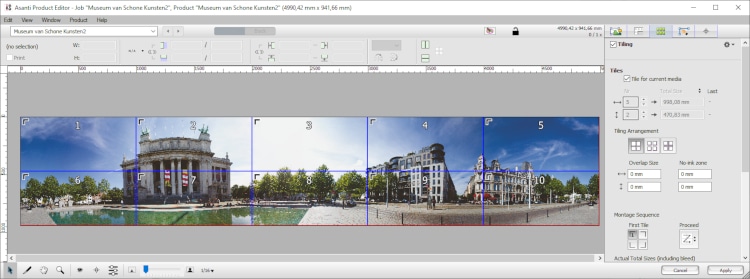
One of the most complex and resource‑intensive tasks when integrating new applications is the creation of accurate color profiles. With Asanti, we automate this process, drastically reducing setup time while ensuring consistent, reliable production. This helps printers incorporate new substrates, devices, or applications faster and with less specialist intervention.
Beyond color management, entire work cycles can be automated through rule‑based logic. Customers can design workflows where incoming files are automatically preflighted, corrected, grouped, and routed directly in the Agfa printer interface, without manual prepress interaction.
Jobs reach the operator only when they are fully ready to print—eliminating bottlenecks, reducing operator errors, and enabling smoother press operation.
As a result, operators spend less time correcting files or redoing jobs and more time focusing on high‑value activities.
What data and analytics does your workflow provide to support better production decision‑making?
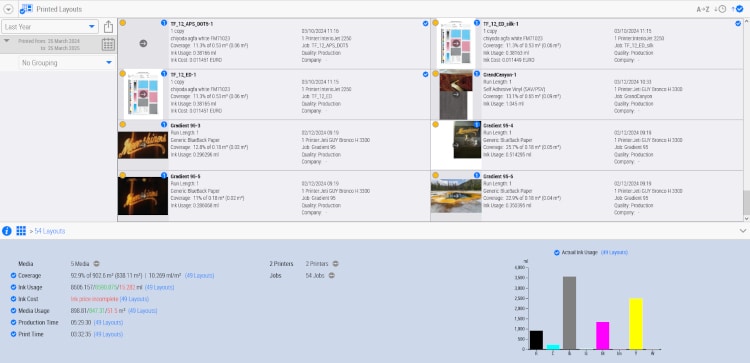
Our workflow solution gives printers full visibility into their production environment—monitoring jobs from submission to completion and delivering actionable insights that drive smarter operational decisions.
A key feature is substrate usage forecasting. For each job, the system predicts substrate requirements and tracks actual consumption, enabling optimized inventory planning and reduced waste.
Detailed reports on substrates, ink, and production time per job improve transparency around cost and profitability, helping identify margin leakage and value creation.
We also provide insights into printer uptime and overall equipment effectiveness. Monitoring uptime trends helps customers understand when presses operate at peak performance and where efficiency can be increased—guiding decisions about asset optimization, scheduling, or investment in additional equipment.
Would you say a good workflow is essential to maximizing ROI?
A solid workflow is essential for maximizing ROI. Without automation, processes become fragmented, increasing labor costs and raising the likelihood of errors—leading to wasted materials and time.
In contrast, optimized rule‑based automation minimizes costs while enabling consistent quality, faster delivery times, and improved margins.
What tools should a workflow include to reduce costs, optimize processes, and increase profitability?
An effective workflow should include comprehensive real‑time KPI monitoring tools. These provide metrics on equipment utilization, operator time, and other key performance indicators—helping identify root causes and areas for improvement. Such data enables managers to optimize machine uptime, reduce consumable waste, and minimize operator downtime, driving continuous process improvement.
Enhanced connectivity and automation also reduce manual errors and increase throughput.
Rule‑based analytical tools facilitate just‑in‑time production and help printing companies allocate resources more efficiently.
How important is staff training for good workflow management?
Staff training is crucial, especially when automating printing and imaging processes. Well‑trained personnel improve print quality and reduce errors, increasing productivity and stabilizing workflows.
Initially, qualified IT and production staff configure automated workflows. Once these workflows are operational, less staff is needed to run them, as automation handles routine tasks.
Ongoing training focuses on areas such as color management and imposition—and can be enhanced with AI to further reduce training needs.
Agfa’s training programs combine advanced configuration skills with optimized operational knowledge, helping improve efficiency without requiring excessive training.
For companies looking to change or upgrade their workflow, what should be considered when choosing a new system?
First, conduct a thorough audit to understand job and equipment performance. Identifying inefficiencies and costs is key to meaningful improvement.
We help our customers track workflows, press utilization, operator time, and production bottlenecks.
If monitoring or data‑collection tools are lacking, acquiring them should be a priority. Workflow intelligence and reporting are essential for sustainable change; without visibility, continuous improvement is impossible.
For customers who already have data available, the next step is to identify three key optimizations:
- reduce job interventions
- optimize equipment usage
- improve operator efficiency
At Agfa, we support customers throughout the entire process—from assessment and analysis to prioritizing changes that deliver maximum return on investment (ROI).
The combination of workflow intelligence and targeted automation enables companies to shift from reactive problem‑solving to proactive, data‑driven decision‑making.